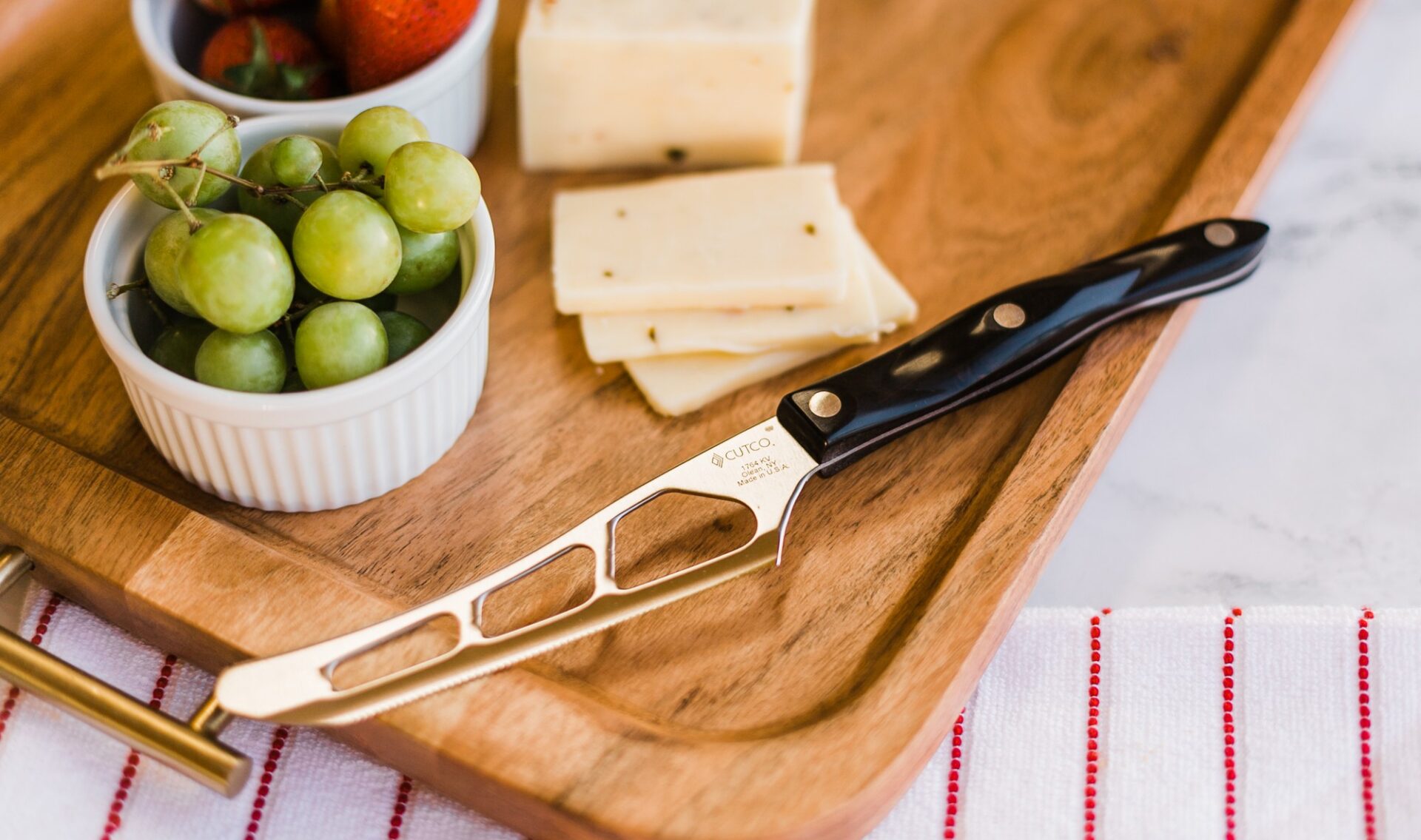
Of every knife I show at a Cutco demo, the one that gets the biggest reaction isn’t the chef knife or the carving knife — it’s the Cutco Traditional Cheese Knife. People pick it up expecting a party accessory, cut one slice of cheddar, and immediately ask what else it can do. I’m Deanna Scortino, “The Knife Gal,” and after 20 years of helping Southern California families choose their Cutco, I can tell you this is one of the most underrated knives in the entire lineup.
This article covers what makes the Traditional Cheese Knife different from the cheese knives in most kitchen drawers, how it handles every kind of cheese, the surprising everyday jobs it does well, and how it compares to Cutco’s other cheese knives.
The Cutco Traditional Cheese Knife at a Glance
When most people search for the Cutco Cheese Knife, they mean the Traditional Cheese Knife (#1764). It’s the full-size model with the signature Cutco handle, it’s one of Cutco’s bestsellers, and it’s the one I recommend first. Here are the basics:
- Blade length: 5-3/8 inches (10-1/2 inches overall)
- Weight: 3 ounces
- Edge: Micro Double-D™
- Blade: 440A high-carbon stainless steel with anti-stick holes
- Handle colors: Classic, Pearl, or Red ergonomic thermo-resin
- Options: Knife only, with sheath, or in a gift box
- Made in: Olean, New York
- Guarantee: The Forever Guarantee, including free sharpening
What Makes the Micro Double-D™ Edge Different
Most Cutco owners know the Double-D® edge from their steak and table knives. It’s a recessed edge with a series of small cutting edges that slice forward, backward, and straight down, while raised points protect those edges from plates and cutting boards. That’s why a Double-D® edge stays sharp so long.
Cutco’s cheese knives use a smaller version called the Micro Double-D™ edge. It’s ground at a finer angle than the edge on Cutco’s other recessed-edge knives, specifically for cheese and cured meats. In practice, the blade glides through a block of cheese instead of crushing it, and you get a clean slice with smooth sides rather than a crumbled wedge. Details like this are a big part of the answer in What Makes Cutco Knives Different From Other Brands?
Why the Holes in the Blade Matter
If you’ve ever cut a soft cheese with an ordinary knife, you know the frustration. The cheese clings to the blade, you scrape it off with your finger, and your slices end up mangled. The holes along the Traditional Cheese Knife solve that:
- Less surface contact. Less steel touching the cheese means less suction holding the slice to the blade.
- Less friction. The knife moves through dense food with noticeably less effort.
- Cleaner slices. Each piece falls away on its own and lands on the board looking the way it should.
This is the moment that sells people at my demos. I slice a soft cheese, the piece drops cleanly onto the board, and the blade comes out nearly clean.
The Cheese Knife Everyone Asks About
Shop the American-made Traditional Cheese Knife in Classic, Pearl, or Red, backed by the Forever Guarantee and my personal local support across Southern California.
Shop My Cutco StoreHow It Handles Every Type of Cheese
- Soft cheeses. Brie, camembert, and fresh mozzarella are where the holes earn their keep. The knife slices through the rind without squashing the center, and the rounded tip doubles as a spreader. For setting out spreadable cheeses at the table, the Cutco Butter Knife makes a lovely companion.
- Semi-firm cheeses. Cheddar, gouda, and havarti are this knife’s sweet spot. You can cut thin, even slices for sandwiches or crackers with almost no pressure.
- Hard and aged cheeses. Aged cheddar and manchego cut cleanly too. For very hard wedges like Parmigiano-Reggiano, I often reach for the Santoku-Style Cheese Knife and its pointed tip.
- Crumbly cheeses. Feta and blue cheese hold together far better with a sharp edge, so you get neat portions instead of a pile of crumbs.
It’s Not Just a Cheese Knife
Here’s the part my clients love most. The same features that make this knife great with cheese make it great with anything dense, sticky, or starchy. Mine lives on the counter, not in a drawer, because I use it nearly every day:
- Tomatoes. The Micro Double-D™ edge bites into tomato skin without squishing the inside. It’s honestly one of the best tomato knives I own.
- Potatoes and root vegetables. Starchy foods usually stick to a blade like glue. The holes let slices fall right off, which makes quick work of scalloped potatoes.
- Cured meats. Salami and summer sausage slice thin and even, exactly what you want for a charcuterie spread.
- Apples and pears. Firm fruit slices cleanly without sticking, so you can fan out pieces on a platter in seconds.
For peeling, coring, and other detail work, I hand off to the Cutco Trimmer Knife.
Traditional vs. Mini vs. Santoku-Style Cheese Knife
Cutco makes several cheese knives, and clients often ask which one they need. All of them share the Micro Double-D™ edge and the anti-stick holes. The difference is size and tip shape.
Traditional Cheese Knife
The full-size, do-it-all model with a 5-3/8 inch blade and a rounded tip for spreading. If you’re only getting one, get this one.
Mini Cheese Knife
A 3-3/4 inch blade that’s ideal for small blocks, soft spreadable cheeses like goat cheese, and tight spaces on a crowded board. It keeps the rounded tip for spreading.
Santoku-Style Cheese Knife
The same compact blade length as the Mini but with a pointed tip, which is perfect for breaking hard cheese into chunks and opening stubborn cheese packaging.
If you love to entertain, the three together cover every cheese you’ll ever serve. I go deeper on building a complete set in Best Cutco Knives for Charcuterie Boards.
Caring for Your Cheese Knife
A few simple habits keep this knife performing like new:
- Hand wash and dry right away. Cutco cutlery is dishwasher safe, but hand washing protects the edge and keeps the handle looking its best.
- Store it properly. A block, tray, or the fitted sheath Cutco makes for this knife keeps the edge from knocking against other utensils. Just like your Cutco Table Knives, keep it out of a crowded drawer.
- Cut on the right surface. Glass, stone, and marble boards dull edges quickly. Wood or Cutco’s polypropylene cutting boards are much gentler.
Sharpening and the Forever Guarantee
Because the Micro Double-D™ edge is recessed and protected, it stays sharp for a long time. When it does need attention, don’t run it through a pull-through sharpener or a honing steel. Recessed edges need specialized tooling, and Cutco sharpens them free under the Forever Guarantee. The only cost is a nominal return shipping and handling fee.
My Southern California clients can also reach out to me directly. You can see how it works in your area in Free Cutco Knife Sharpening in Glendale, Cutco Knife Sharpening in Los Angeles, Cutco Knife Sharpening in Ventura, and Free Cutco Knife Sharpening in Orange County.
The guarantee covers performance for as long as you own the knife, whether you bought it yourself or received it as a gift. If you’re curious how long a well-cared-for Cutco really lasts, I dig into that in How Long Do Cutco Knives Last?
Is the Traditional Cheese Knife a Good Gift?
It’s one of my most popular gifts, period. It’s useful in every kitchen, and nearly everyone who receives one ends up using it for far more than cheese:
- Gift-ready. Order it in a gift box and have it personalized with a name, a monogram, or a short message on the blade or handle.
- Weddings. Couples often ask me whether Cutco belongs on their registry, and this knife is one of my favorite answers. I share more ideas in Is Cutco a Good Wedding Gift?
- Realtors. It’s a staple in the Cutco Closing Gifts I put together for agents and their buyers.
- Businesses. Business owners order them in bulk for clients and employees, and I explain how that works in Cutco Business Gifts.
Questions I Get About the Cutco Traditional Cheese Knife
Is the Cutco Traditional Cheese Knife serrated?
Not in the traditional sense. It uses the Micro Double-D™ edge, a recessed edge with small protected cutting surfaces. It cuts more cleanly than a standard serrated blade and won’t tear soft cheese.
What else can I use it for?
Tomatoes, potatoes, root vegetables, cured meats, apples, and pears all slice beautifully with it. Anything dense or starchy that tends to stick to a blade is a great match.
Can it go in the dishwasher?
It’s dishwasher safe, but hand washing and drying right away keeps the handle looking new and protects the edge.
Can I sharpen it at home?
No. The recessed edge needs specialized equipment. Send it to Cutco for free sharpening under the Forever Guarantee, or reach out to me and I’ll help you get it serviced.
Which Cutco cheese knife should I buy first?
Start with the Traditional Cheese Knife. It handles the widest range of cheeses and kitchen tasks. Add the Mini or the Santoku-Style later if you entertain often.
What handle colors does it come in?
Classic, Pearl, and Red. All three perform the same, so choose the one that matches your kitchen or your other Cutco pieces.
Is it made in the USA?
Yes. Like all Cutco knives, it’s made at the Cutco factory in Olean, New York.
Buy It for the Cheese Board, Keep It for Everything Else
Of all the knives I show people, this is the one that surprises them most. Buy it for your cheese board, and I promise you’ll find yourself grabbing it for dinner prep all week long. If you’re still weighing the investment, I lay it out plainly in Are Cutco Knives Worth It?
Learn more about working with a Cutco Representative Southern California, read every purchasing route in How Do I Buy Cutco Knives?, shop anytime at my online store, or schedule a free, no-obligation demonstration at theknifegal.com or by calling (323) 205-5288.
Los Angeles, Orange County, Ventura County — let’s get a Traditional Cheese Knife on your board.
This Weeks Featured Product
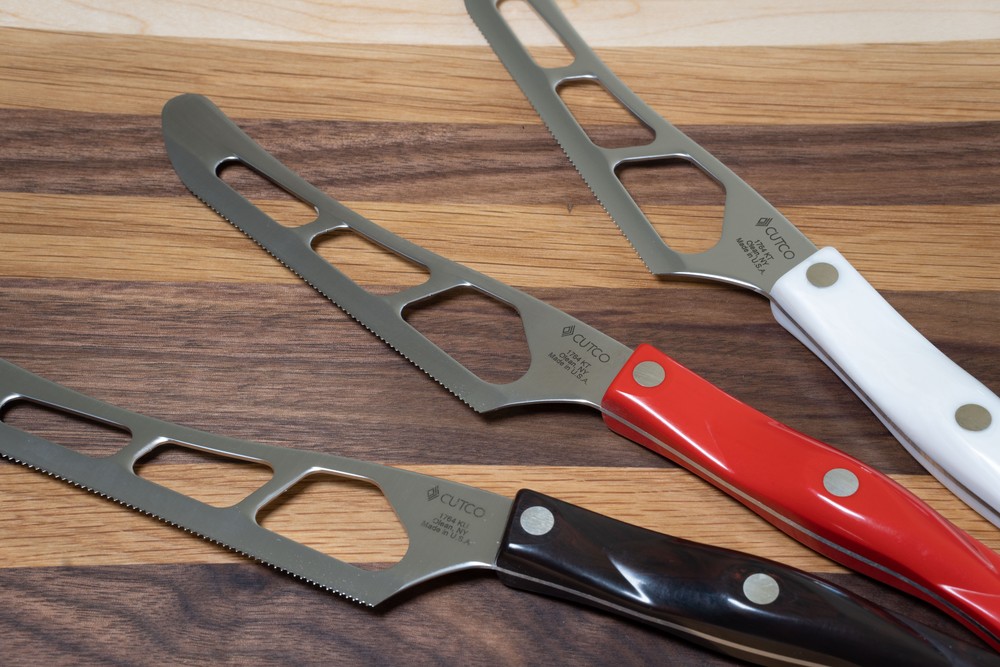
Cutco’s Traditional Cheese Knife
Slice brie to aged cheddar without sticking. The Micro Double-D™ edge glides while blade holes release every slice. American-made, guaranteed forever with free sharpening, perfect for tomatoes, potatoes, and charcuterie.